
A palace within a living city
UNESCO describes the Medina of Marrakesh as a living historic town of lanes, houses, souks and traditional trades. Bahia is one part of that setting. Read UNESCO’s description of the medina.
The title Building Marrakesh is an invitation to read the city through its architecture. This editorial guide is published by Apollo Trading UG, the independent company behind this booking website. It describes places and materials; it does not represent a building or restoration programme.
From a threshold to a courtyard
Choose a single transition to notice during your visit. Stand where a doorway frames the space beyond, then compare that view with what becomes visible as you move forward. An interior can feel very different when seen from its centre or from its edge. Looking back occasionally reveals relationships that are easy to miss when following a continuous route.
In the garden photograph used elsewhere on this website, planting, tiled paths and a fountain share the foreground with a decorated facade beyond. Try giving the space between these elements as much attention as the ornament itself. You do not need an architectural vocabulary to notice proportion, repetition or a change in light.
Read the surfaces
The Moroccan National Tourist Office highlights Bahia’s zellige, marble and gardens. Its description is a useful starting point for deciding what to look for. Read the Bahia Palace entry.
- Follow a pattern. Choose one repeated shape and trace how it meets a border or changes direction at a corner.
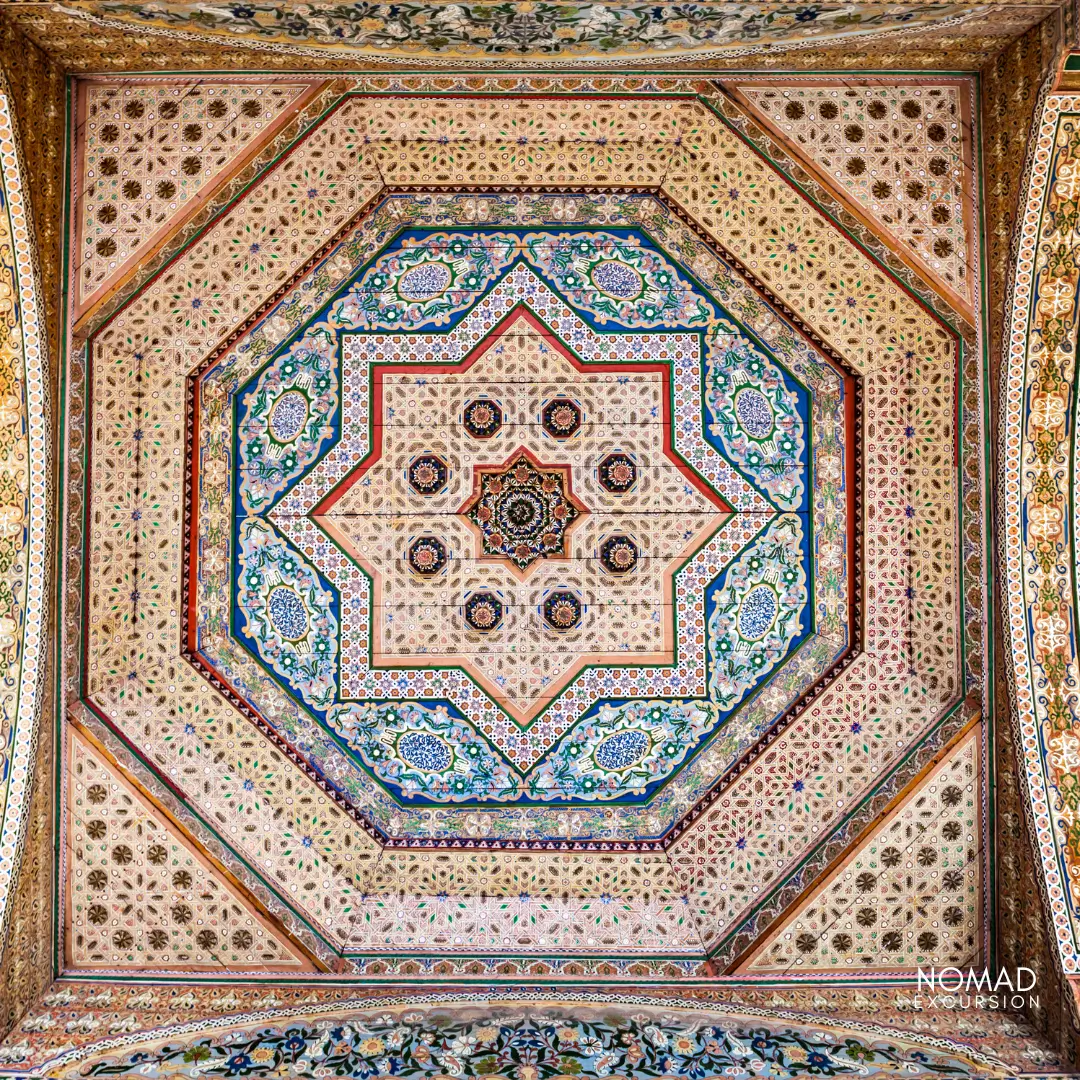
- Look upwards. The ceiling photograph above shows how colour and geometry can organise a whole surface. Compare the centre with the surrounding bands.
- Notice a frame. Look at the relationship between an opening and its decorative surround, then step back to see the complete wall.
For a wider introduction, the Tourist Office’s craft guide discusses wood decoration, plaster and zellige among Morocco’s craft traditions. These categories can help organise your observations without assuming that every surface has the same maker or date. Explore Moroccan craftsmanship.
Looking with care
Give other visitors room to pass, follow the route indicated on site and observe decorated surfaces without touching them. In the surrounding neighbourhood, remember that a doorway may belong to someone’s home or workplace. A thoughtful photograph begins with attention to the people sharing the space.
To place your observations in time, explore the Timeline. For more reading on the palace, continue to Heritage or browse the selection in Stories.